

MAY
Shank Fest, Cooking School and Coconut Cake



Shank Fest. Lamb, in particular, Lynn’s lamb from her Dashing Star Farm, is one of our favorite spring delights. So we’re celebrating it! On Saturday, May 23, we’ll herd you upstairs for a night of folk music, chilled reds, and lamb. Tickets here.
Cooking School returns for summer. On June 19 and July 10, Cooking School is in session. Clare will take the barn stage to school us in effortless, summer entertaining. Plan to cook, plan to eat, and plan to learn something… all with a martini in hand. Book your cutting board here.
Coconut Cakes for Mother’s Day. 99 out of 100 mothers would love a tall, fluffy coconut cake. Pre-order and pick one up here on Sunday, May 10, from 1–3pm to slice after supper at home. Pre-order here.

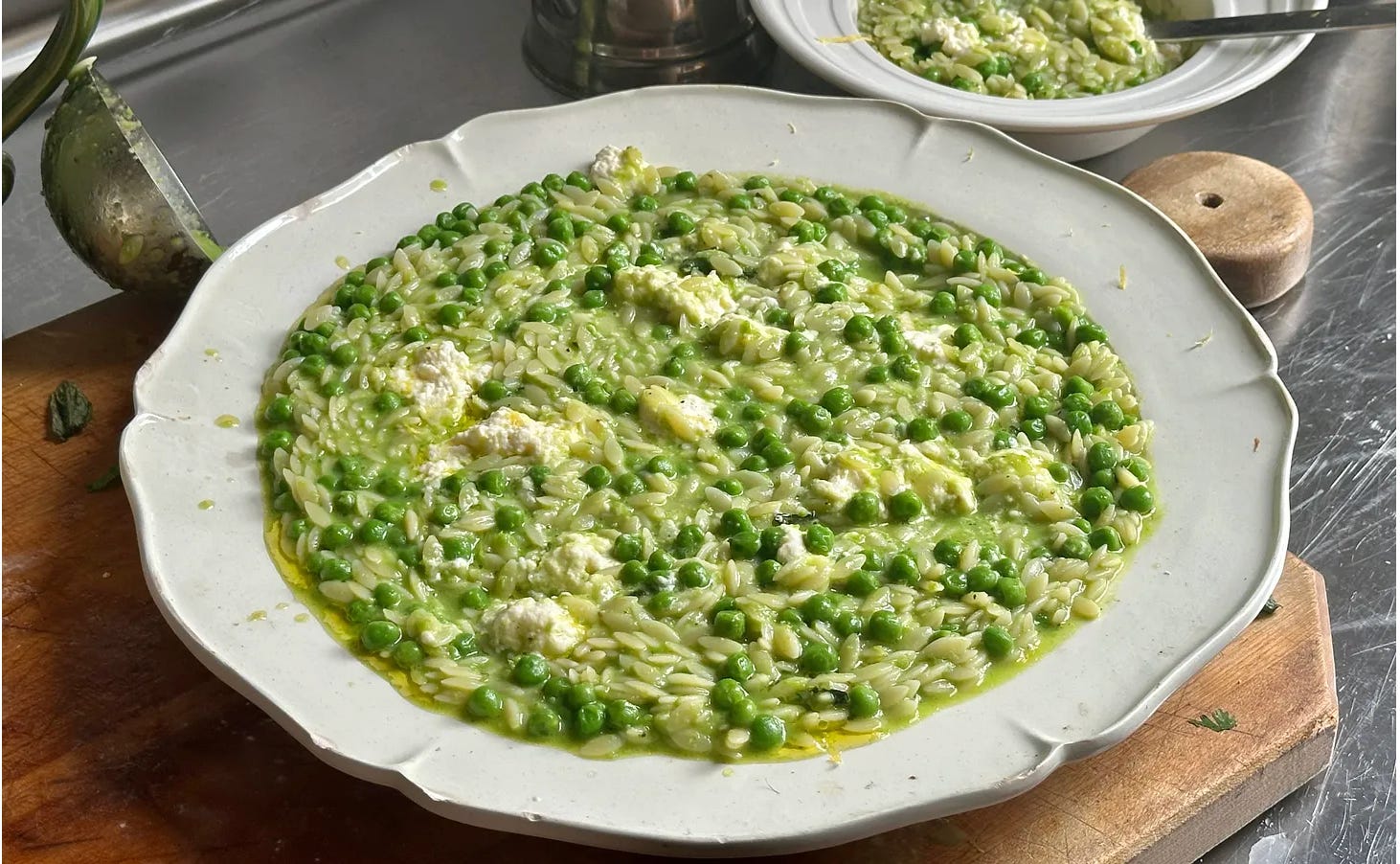
Risi e bisi is a Venetian dish halfway between risotto and soup, made with rice and spring’s first peas. This version uses frozen ones and orzo instead, but has the same soft sweetness as the Italian original.
You begin by blanching peas and a handful of mint leaves, which flavor the orzo-cooking broth before being blitzed into a purée. Then, once you’ve cooked the orzo in the souped-up broth, you add more whole peas to the pot and stir through the ones you’ve blitzed. It’s entirely green, and its voluptuousness is only exaggerated with spoons of ricotta added at the end. Read more about it on The Best Bit here.

An interview with Matt Sheehan of Fengrown
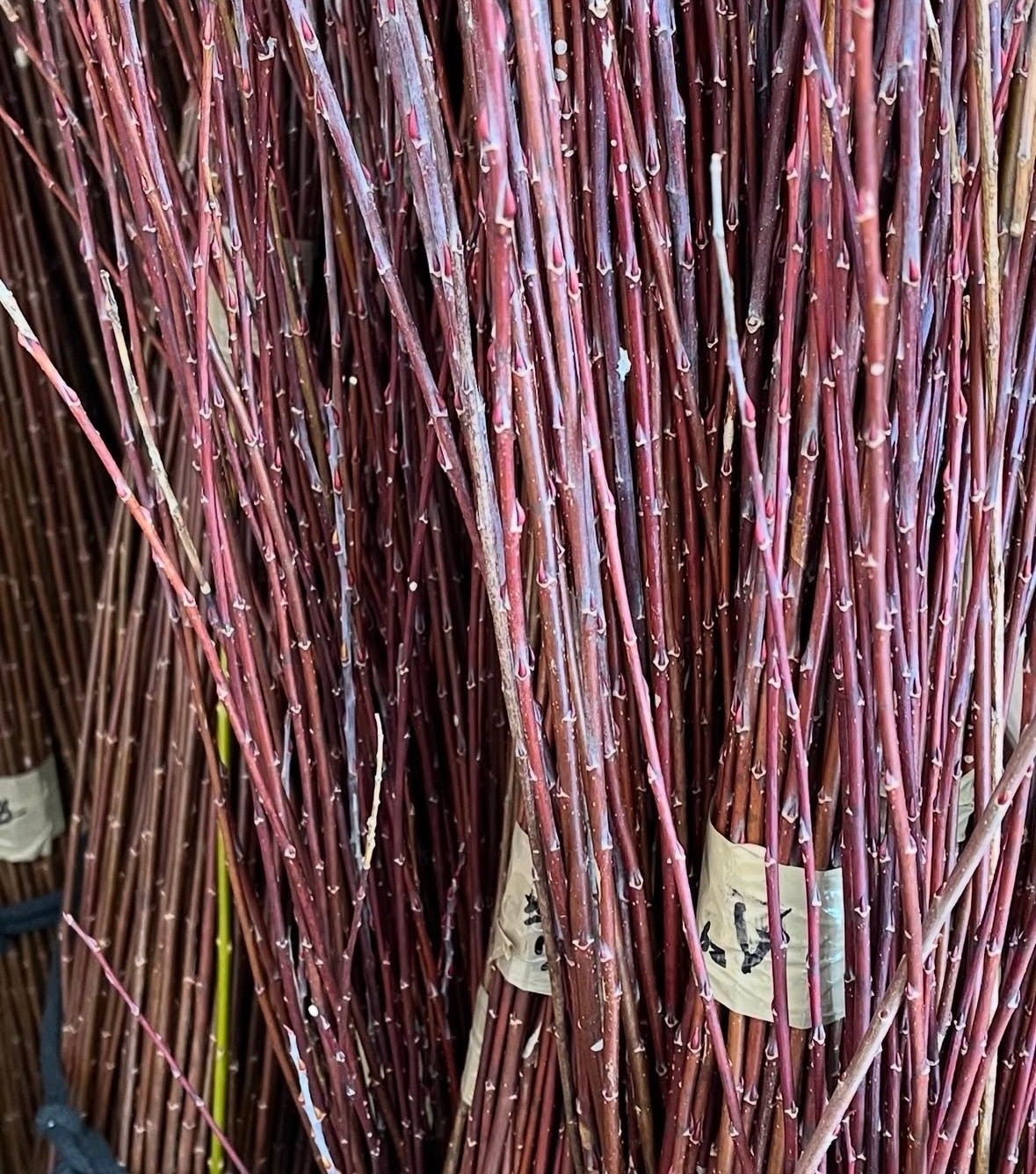
What started as a conversation with Matt Sheehan about growing willow turned into the kind of philosophical dialogue we love. Matt lives on an old dairy farm in Sharon, CT where the soil flatly refused his early fantasies of blueberries. The heavy, wet clay wanted willow. Even the surrounding drainage ditches filled themselves with willow on their own. Four seasons later, Matt has roughly five thousand plants (of 13 varieties) on a half acre, and “membership” in a tightly woven circle that includes former magazine editor turned basket maker Deborah Needleman, Jesica Clark of Willow Vale Farm, and a rotating cast of weavers and students who turn up for Jesica’s week-long classes.
Matt is (quietly) part of the Stissing House craft circle. He doesn’t have a stall at the farmers market or a storefront with his name on it; instead, he grows for the makers. His willow goes to Jesica at Willow Vale Farm where it’s woven into baskets and wattles (low garden fences), and into the hands of Jesica’s students. His winterberry and floral cuttings go to Kate at Foxtrot Flowers in Stanfordville. The native seeds he raises on his property go to the Northeast Seed Collective, where they’re packaged for backyard meadows across the region. His fruit travels to the Millerton farmers market through Ellie at Thistle Pass Farm. His dear friend Pom Shillingford of English Garden Grown visits often to forage in the woodlands and meadows to enhance her stunning floral arrangements for Stissing House. Craft, slow living, and hyper-local supply chains—all held together by intentional relationships.
What Matt is actually selling, if you listen closely, is connection. “Food is a really great way to get people connected,” he says, “and craft is an amazing way to get people connected, especially craft with plants…we gotta figure out ways to get people outside, and begin to have a real, fruitful dialogue with the natural world.” Matt believes the solutions to most of what ails us are hyper-local. That farmer’s markets and shared meals and basket classes are not lifestyle accessories but the actual work. Read more below from our discussion.
What has farming on wet clay taught you about working with a place instead of against it, and how does that show up in the rest of how you live?
I need to listen more. I have so many very ‘grand’ ideas. With age, I have let those ideas marinate a lot longer before I act. I bind my hands and try to observe the situation from every angle. Always asking myself, “What harm will this grand idea unleash upon the land and its many non-human inhabitants?” Case in point: Friday night, after manifesting a beaver for 15 years, a mating pair arrived in a pond on my property. As a human, I said “Wrong pond, dammit!” and I began scheming. “I know! I will move them!” I marinated. As a result, the beaver couple will remain, have a family, and I may no longer have raspberries.
You spent more than a decade as a public school teacher in Brooklyn where you started a garden for students at The Brooklyn New School, followed by starting Edgemere Farm in Far Rockaway, and now growing here. When you look back, what’s the through line?
I think Harry Truman said this: “It is amazing what you can accomplish if you do not care who gets the credit.” So many people participated in those projects, and because we all (I think) wanted the project to succeed, its completion came first. As a result, each of those very special community works still exist and are thriving. NB: Please don’t think I am some saint and that every cell in my body did not want attention and credit. I tried to fight that urge and still do. Ram Das sums up my life’s mantra: Becoming nobody.
What were you trying to do with your students and with the Far Rockaway community that you’re still trying to do here?
As my dear friend David said to me, “I want to build the community within which I want to live.” Bringing people together around shared experiences that are honest, and in my opinion essential, is rewarding. When we work together on something meaningful and put the task first, we learn so much about each other. Our habits, our shortcomings. And through those very difficult moments, we hopefully lose self and develop a bond. Although it may seem trite, making a basket over two days with the same ten people, all with different skills, is a strange bonding experience.
You said that we can sit and process climate change and the environment all we want, but unless people are out engaging with the environment, it stays abstract. What does an on-ramp look like for someone who’s never knelt in a meadow, grown a garden, or held a basket rod?
Walking and listening. Not walking to get steps, not walking to burn calories, not walking to get somewhere. Leave the phone at home, take the watch and aura ring off and walk and listen. Real slow. Sit on a rock if you get tired, and study the rock. The natural world is an unfathomable subtle place that holds all the answers. Nature is the most exquisite artist, landscape architect, philosopher, successful business person, philanthropist. We must deeply embrace that we are ‘part of’ not ‘separate from.’
Your business model is unusual in that most of what you grow moves through other people: Jesica, their students, Foxtrot’s bouquets, Thistle Pass Farm’s market table, the Northeast Seed Collective’s seed packets, the tincture maker who buys your elderberry. Why do you prefer to be the grower behind those brands rather than the brand yourself?
See above. Truman and Ram Das guide me…mostly. For example, getting eco-typic seeds into the hands of a land steward who plants them and grows a tiny meadow to enhance habitat is far more important than me and my BRAND. I started growing white oak trees from seed I gathered. It feels so good to give someone a white oak seedling rather than some object I bought.
You talk about hyper-local as the answer, and also about how local food has been priced into a corner where a lot of people can’t reach it. What would a more honest, more accessible version of local actually look like in a place like ours?
The million dollar question! Farming (I don’t really like that word…topic for another discussion) is so hard. Farming in this region is even harder. Sadly, I don’t know if there is an answer. This much I know: the price of food at the grocery store is as unsustainable - for different reasons- as that at the farmers market. Elspeth Hay in her book, Feed Us with Trees: Nuts and the Future of Food, makes a far more compelling argument than I could ever make. The hippie in me wants to have weekly potlucks on my road. Ones at which no one asks where the lettuce was grown and if the bread is made of Einkorn. We need to break bread more often and embrace our humanness.
You mentioned wanting to host a dinner once a year to thank the people who grind without ever being celebrated: farmers, mechanics, plumbers, the weed-whacker guy. What’s your entertaining vision, what are they eating, and what is it you most want them to hear?
I want to listen. I want to eat the food they eat. Walter Pezantes and I have a cookout in the summer. We eat a chicken that’s grilled on a homemade barbeque. I listen to his dreams for his land in Ecuador. Too often it’s me asking for his help. Or me blabbing about native plants. We have so much to learn from each other, but never afford ourselves the time to gather and listen. I, too often, find myself in one-sided relationships where I am asking for something to get done. I fear we have created a caste system of our very own right here in the US of A.
Later this year, you’re heading to the Tear Up Festival in England where you’re hunting more exotic willow varieties, and you’re starting to imagine the things you want to build with willow, from wattle fences to garden structures. What does the next chapter of this work look like for you, and what do you hope it makes possible for the people around you?
Craft is so much a part of other cultures. While I think it has a strong foot hold here, and is gaining momentum, it is my experience that we are all learning. The multigenerational weaver is hard to come by in this country. America is so young that the lineage is not there. We also love cheap and fast—words that are antithetical to craft. The indigenous people of this land are artists and craftspeople of immense talent. Honoring them would be a wonderful first step in deepening our love and respect of craft. As an aside, I love hosting classes with guest teachers. I would love to do more of that as well.
QUICKFIRE
Always: Planting trees
Never: Hatless
A daily ritual: The 100 yard walk from my house to the barn in the very early morning. The power of the universe seems unbridled.
Listening to or reading: Tinariwan’s new album Hoggar and anything by Zoh Amba.
Favorite willow resource: Peter Dibble basket maker and epic willow fence maker.
Matt is the best! I loved this!