

Dream-weaving
A bedtime story for the night before Craft Feast


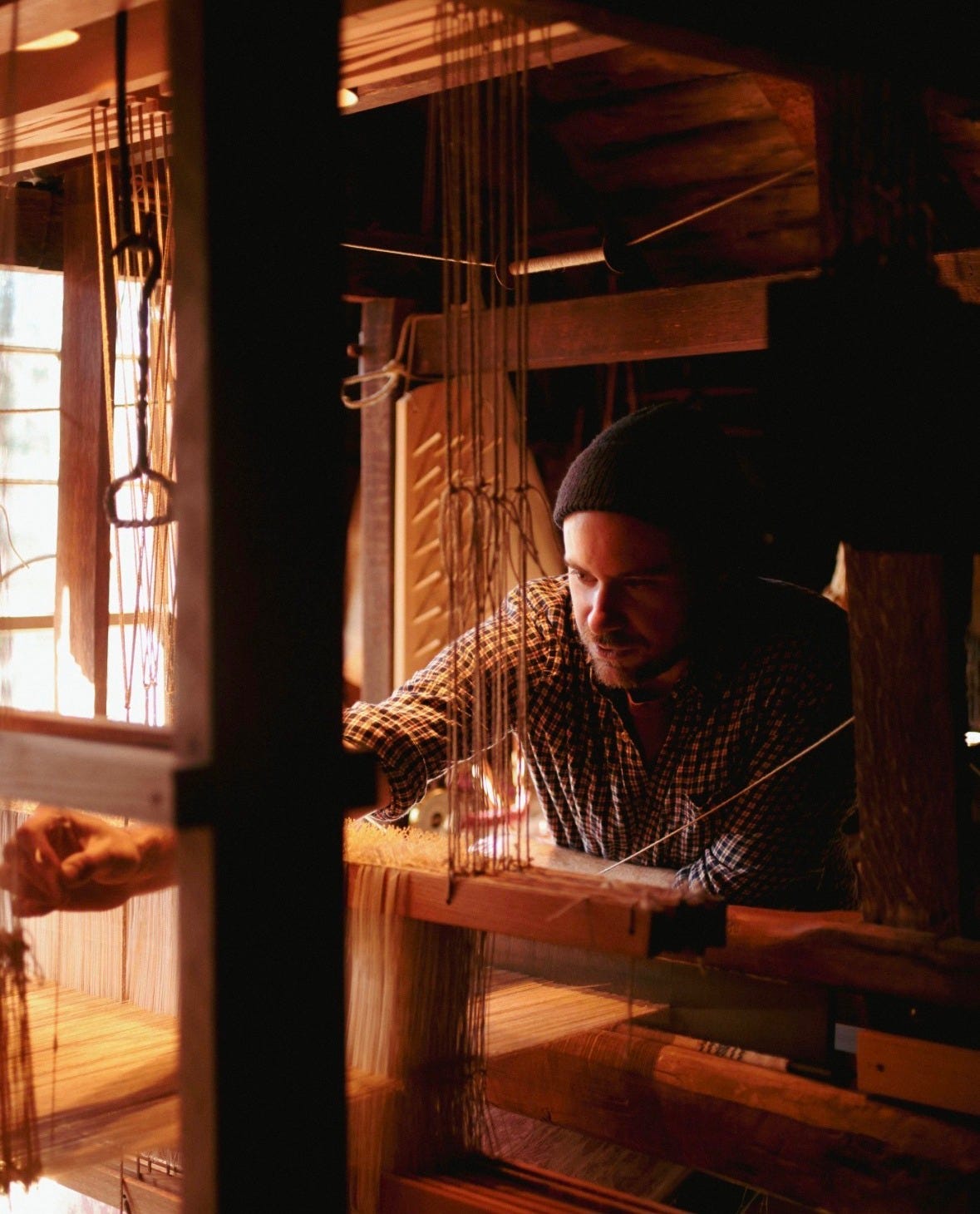
An interview with Justin Squizzero of The Burroughs Garret
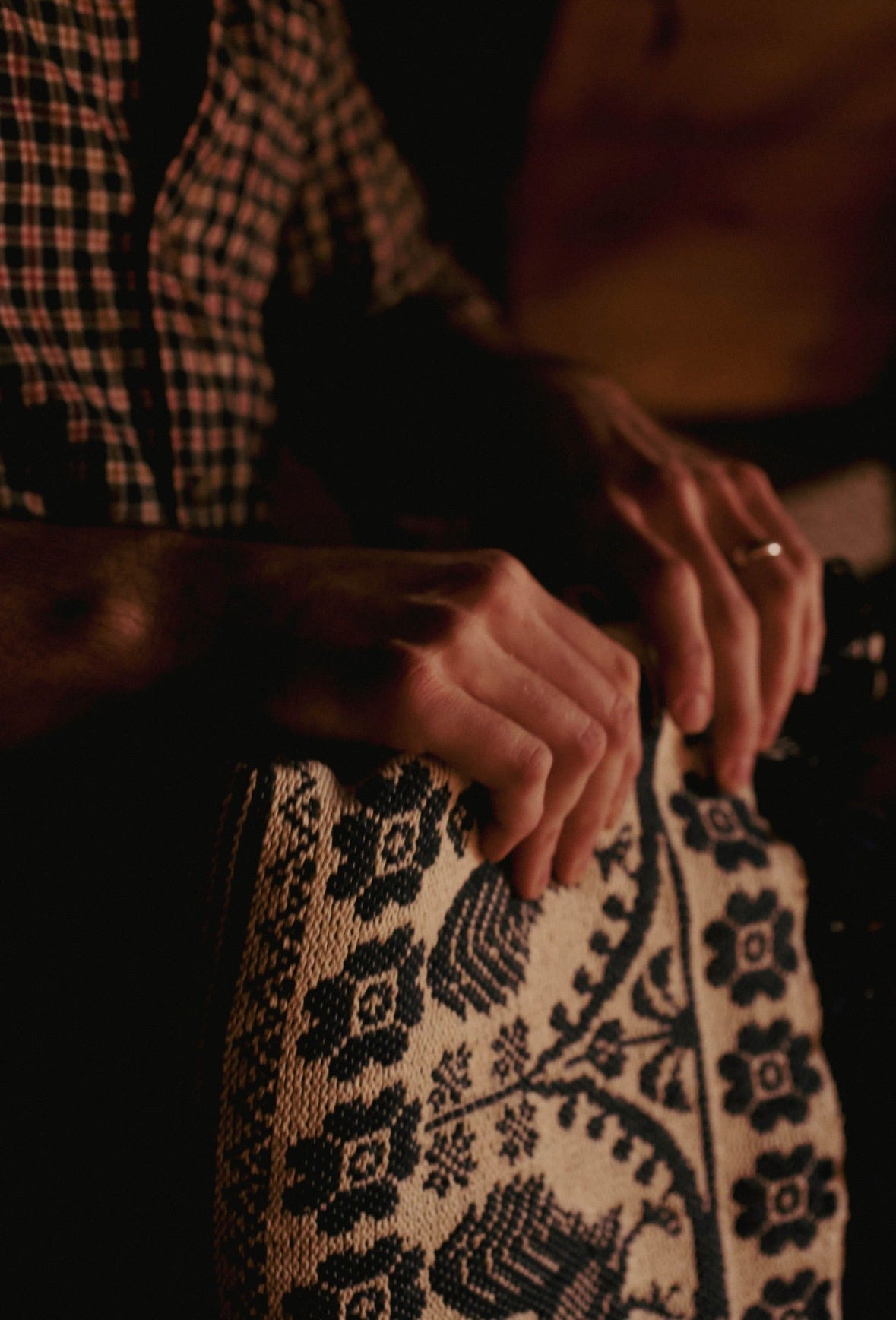
Lucky us, we are welcoming The Burroughs Garret to Craft Feast this weekend. Founded by handweaver Justin Squizzero, The Burroughs Garret is both a place and a principle. What Justin is bringing to Craft Feast (his first time participating in a craft fair) represents months of painstaking work: napkins woven on a vintage Jacquard loom, based on a 17th-century Dutch design from the Rijksmuseum. Each piece involves 3,000 warp threads and takes a full (long) day to weave. The design itself, a whimsical hodgepodge of ships, sea monsters, mermaids, and navigational tools, took weeks to translate from historical photograph to punch cards, adapting the original pattern to work with his loom’s 500 individual hooks.
Justin’s path to becoming a linen damask weaver reads like a series of fortunate alignments: learning to spin as a child; apprenticing with master weavers during museum off-seasons; and then, in 2019, the kind of serendipity you couldn’t script–discovering a historic Jacquard loom built specifically for figured linen damask weaving. The loom had traveled from Northern Ireland’s damask industry to Scotland, and finally to him–the exact tool he’d been searching for, appearing at precisely the right moment.
For Justin, the real art isn’t just in the finished cloth. It’s in the entire process, from the mathematics of the weave structure to the mechanical poetry of the Jacquard’s operation. He’s drawn to historical reproduction work, to “copying the work of dead people,” as he puts it, but he finds freedom in the constraints of tradition. Whether he’s a textile artist or a performance artist whose medium happens to be movement and material, he’s not quite sure. What’s certain is that he’s keeping alive a centuries-old craft that once required two operators and now, thanks to Joseph Marie Jacquard’s 1800s innovation, can be accomplished by one patient weaver in rural Vermont.
Your grandmother was a weaver and dyer–how did your time with her shape who you are, both as a person and a weaver?
My grandmother is very much responsible for where I am now, though neither of us ever would have guessed it. My earliest memories of her are sitting on her living room floor picking fleece that she would later card and spin into yarn. She was always knitting or engaged in some kind of textile craft and that really seeped into my bones as a kid. She taught me how to spin when I was ten or eleven on a 200-year-old great wheel that descended in the family, so there’s always been a strong connection between past and present when it comes to textiles for me.
What is your point of view, and how did it develop?
Fundamentally I think it comes down to a constant skepticism that new equals better. I’m forever curious about what is lost when something is gained, and to critically evaluate whether the new thing is actually an improvement over the old. What we’ve gained in convenience and volume through manufacturing has come at the expense of the environment and exploited labor. We’ve gained distant connections through the internet at the cost of relationships with the people who live next door. I try to avoid an unrealistic nostalgia for “the way things used to be”—much of the past was pretty terrible for a lot of people—but I do believe that the transformations of the 20th and 21st centuries have come at the cost of a little bit of our souls. My approach to clothmaking is intrinsically tied into this question of what it means to be alive in our modern age. What would the world look like if we accepted the “new” only after carefully considering what will be lost in the process?
You’ve said that without the process behind it, the textile doesn’t have much value, and without the finished product, the process doesn’t either. Can you talk more about that relationship?
At times I’ve really questioned whether I’m a material artisan or performance artist, and ultimately I think I’m both. I’m primarily drawn to process, to the how and why, and using that to pursue knowledge and skill that was painstakingly developed over many centuries and which we abandoned to a large degree over the last 150 years. Those skills only exist when embodied by the hands of the weaver, they don’t exist in any other form. You can write about them, you can record them on video, but like a musical score, the song only exists while the bow is moving across the strings of the fiddle. Acting as a vessel for those skills to inhabit is what I’ve spent the last twenty-three years attempting, and yet the creation of the cloth is the whole point of the skill. Just as the process doesn’t exist when it isn’t in use, the craft can’t fully exist when it’s been stuffed and mounted in the captivity of a museum. It needs to be out in the wild, producing cloth to be consumed. Cloth that contains the value of not just the material, but the intangible craft that fashioned it. The skill gives meaning to the object, the object gives meaning to the skill.
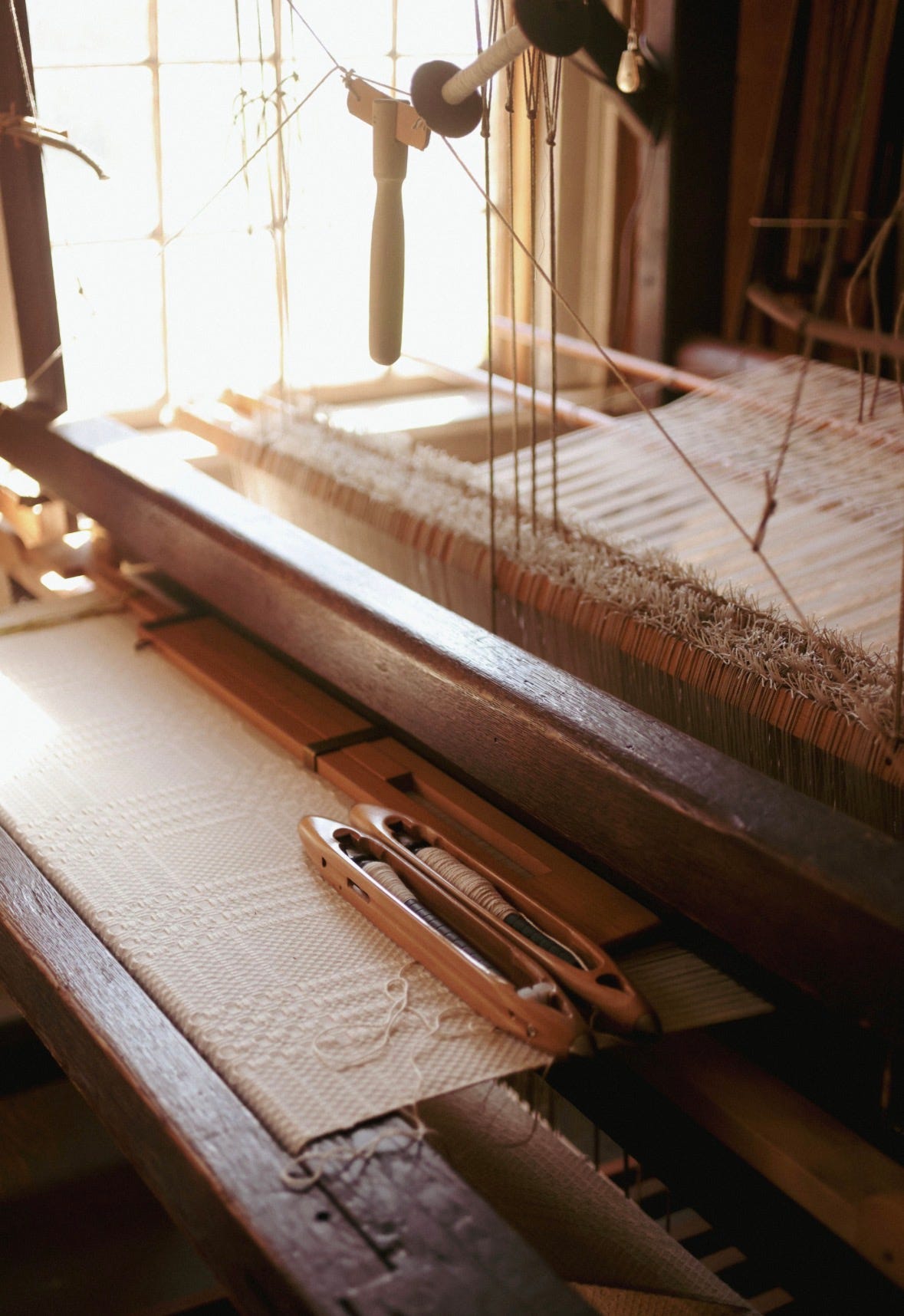
Craft Feast will be the first time you’ve sold work that wasn’t commissioned. What made you decide to take the leap, and how does it feel to be producing pieces for unknown buyers?
It would take an awful lot to entice me to most craft shows, but Stissing House’s Craft Feast captures much of the spirit that I try to bring to my work. Craft Feast is a celebration of authenticity and the human hand, and, uh, well, the food…need I say more? I’m excited to share my linen with folks who may not have encountered handwoven cloth in this way before, and to hopefully inspire them by its beauty and what it represents.
The napkin design you’re bringing features mermaids, ships, and navigational tools. What was it about this particular 17th-century Dutch design that made you want to reproduce it?
I think of linen damask from the 17th century as falling into three main categories: armorial, biblical, and everything else. The armorial designs have limited appeal beyond the noble families they represent. The biblical stories were often depicted through multiple scenes that were woven as a continuous length of fabric and which were cut to napkin length. This would sever figures wherever a hem happened to land, making them hard to establish a full design repeat and perhaps less saleable in today’s market. Of “everything else,” I absolutely loved the ships on this one, especially the two ships firing their “stern chasers” at each other. The port city at the top of the napkin has a great rendering of buildings in the style of the period which I also really love. It has a relaxed, quirky aesthetic that feels very human to me.
Is there a technique or craft you haven’t tried, but would like to explore?
The beauty of weaving is that it’s such a vast field it’s impossible to learn it all. I would like to do more passementerie weaving, that is, weaving narrow trims. The technology is very different from that used for making wide cloth and I love that after all these years I can still approach an aspect of weaving that I know almost nothing about.
While we know you’re in it for the process, not the finished product, you must sometimes imagine how these pieces exist in the world. Describe a dream dinner party (or any other scenario/s), down to the guests, where your napkins are used:
This one is easy because the party already exists, the dream part is handwoven damask napkins for all. Every year we host a Twelfth Night party with forty or more of our closest friends and neighbors. It’s usually cold and snowy outside, but the woodstoves are cranking inside. We fire one of our brick ovens and cook mincemeat pies, cake, and duck from 17th-century sources, and we have multiple bowls of Charles Dickens’ rum and brandy punch (which you set on fire, like any good beverage). The house is lit by candles, including the Christmas tree, and we throw together a Mummer’s Play wherein Saint George slays a dragon. Repeatedly. The evening is perfect because nothing is perfect. Our house is too small and the looms are too big for the number of guests. The dishes don’t match and there aren’t enough chairs, but everyone manages to gather around the fires and take part in a celebration the way we’ve been coming together for hundreds of years. You could take the same people and put them in a different setting, but without the old house, the handmade stuff, and the fire, it wouldn’t work. Hopefully before too long there will be linen mermaids and ships flashing in the candlelight on the laps of every guest.
Quick Picks:
Hours spent weaving one napkin for Craft Feast: 12+, not including setup or hand-finishing.
Weaving soundtrack: Preparing for Craft Feast it’s been Traditional & Modern Carols by the Pro Arte Singers, or a playlist of disco hits depending on how far behind my benchmarks I am. Life is about balance.
Daily ritual: Evening chores. Feed and water the pigs, sheep, cow, poultry. Bring in firewood. Watch the sun begin to set.
The best book you’ve read this year: The Memory Palace by Nate DiMeo.
A go-to holiday gift: A quart of homemade maple syrup or canned tomatoes. Same gift for birthdays, housewarmings, etc.
Favorite holiday movie: A Muppet Christmas Carol (the full version). Sir Michael Caine is the Ebenezer Scrooge we need and don’t deserve.
Photos by Ben Ashby.